
On the morning of March 20, 2026, a strategic meeting was held at the Furama International Convention Center (Furama Resort Danang) to accelerate the elevation of the city’s destination status. The event “Implementing Security and Safety Assurance: Digital Transformation Application and Improving Service Quality for Tourists in Danang City,” chaired by the Department of Tourism, opened up new directions amidst a challenging global context.
Danang discusses tourism security strategy, aiming for nearly 20 million visitors in 2026.
Against the backdrop of global tourism undergoing many political fluctuations, Danang is accelerating its strategy to elevate the destination through a meeting on the morning of March 20, 2026, held at the Furama International Convention Center, Furama Resort Danang: “Implementing Security and Safety Assurance: Digital Transformation Application and Improving Service Quality for Tourists in Danang City.”
According to reports within the framework of the meeting, the city recorded a total of 17.8 million visitors served by accommodation establishments (2025), an 18.3% increase compared to 2024. Of these, international visitors reached 7.7 million, showing positive signals from the inbound market. In just the first two months of 2026, the number of visitors reached nearly 2.5 million, an 11% increase over the same period. On this growth momentum, Danang aims to welcome nearly 20 million visitors in 2026, continuing to consolidate its position as one of the leading dynamic destinations in the region.

Overview of the meeting “Implementing Security and Safety Assurance: Digital Transformation Application and Improving Service Quality for Tourists in Danang City” organized by the Danang City Department of Tourism.
A difficult problem from global fluctuations
However, these positive signals are facing major challenges from the global political context. Prolonged conflicts in the Middle East have been creating many negative impacts on the global tourism value chain, especially the increase in fuel costs and pressure on the aviation industry.
At the meeting, Ms. Nguyen Thi Hoai An – Deputy Director of the Danang City Department of Tourism, shared: “The developments of the conflict in the Middle East are an important link in the chain connecting global tourism markets. Fluctuations in costs, especially transportation costs, are directly impacting the decisions of potential international visitor groups that Danang targets. This is also the focus segment for many accommodation establishments in Hoi An and neighboring areas. Therefore, businesses need to proactively consider and adjust their business strategies to adapt to the new context.”
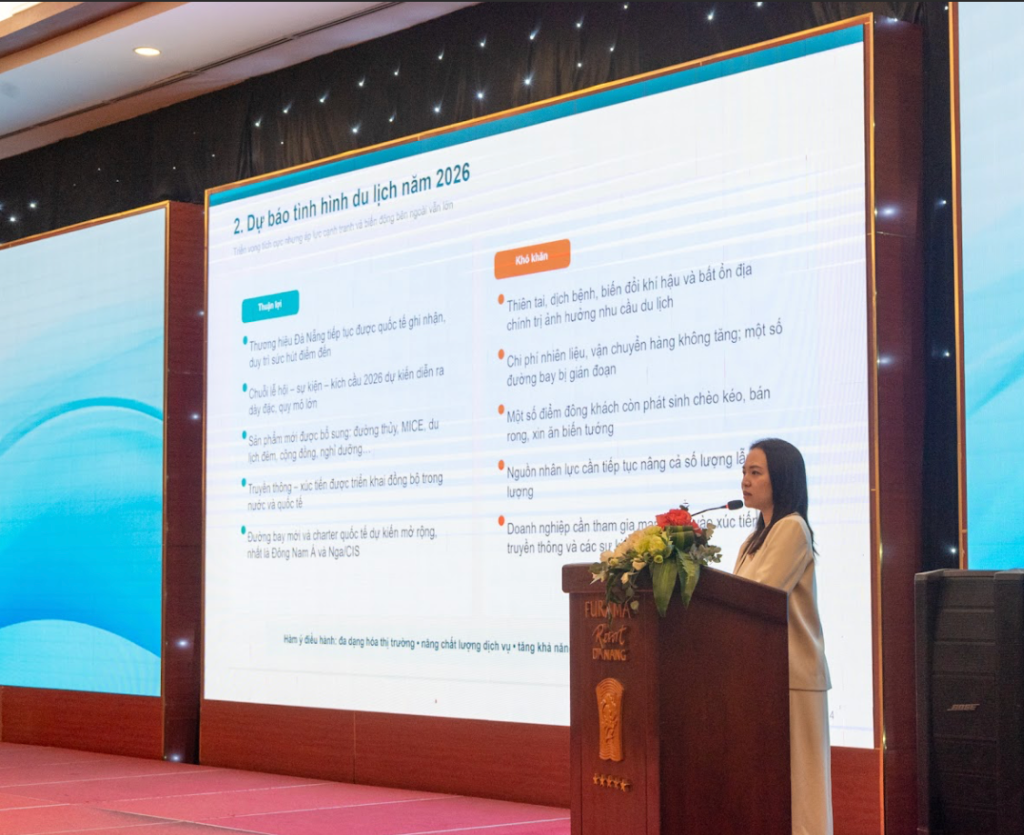
Ms. Nguyen Thi Hoai An – Deputy Director of the Danang City Department of Tourism, sharing her thoughts
Looking back at today’s tourism industry fluctuations, Mr. Nguyen Duc Quynh – Vice Chairman of the Danang Tourism Association – General Director of Bac My An Tourism Joint Stock Company (Furama Resort Danang) emphasized the practical pressures: “Airlines have begun applying fuel surcharges, while gasoline prices have just recorded an increase, exceeding the threshold of 30,000 VND/liter.”

Mr. Nguyen Duc Quynh – General Director of Bac My An Tourism Joint Stock Company (Furama Resort Danang), sharing his thoughts
“High fuel prices lead to escalating air transport costs, forcing many airlines to adjust their flight frequencies and route structures. This affects the accessibility for international tourists, while also increasing cost pressure on the entire industry, from travel agencies to accommodation establishments.”

Index of the impact of Middle East political conflicts on Vietnam’s tourism
The adaptation problem: Security, digital transformation, and long-term vision
In this context, Danang city is shifting from a reactive mindset to proactively designing a development model capable of active adaptation. The focus is placed on promoting digital transformation and innovating business methods. At the same time, security is always at the center, not only ensuring destination safety for tourists such as compliance with security, safety, fire prevention, and food safety regulations but also building a transparent, stable, and reliable tourism environment for the entire ecosystem, from tourists to businesses. This includes tightening price management, standardizing service quality, and raising the operational awareness of suppliers to ensure a consistent experience at every touchpoint of the travel journey.
Sharing about solutions, Mr. Nguyen Duc Quynh proposed a 3-layer adaptation strategy.
First, handling price shocks and stabilizing the market, operating with flexible price policy adjustments. Hotels need to coordinate closely with airlines and OTAs to implement joint sales programs. Second, adapting and restructuring visitor flows, increasing the proportion of visitors from CIS, Asia, especially India and ASEAN, and Australia to reduce dependence on distant markets like Europe and the US. And finally, Vietnam and especially Danang city need to be consistently positioned as a safe, stable destination with high value relative to cost.
From a long-term perspective, the Vice Chairman of the Danang Tourism Association believes that building a safe, stable destination that provides value worthy of the cost is no longer just a communication choice but has become a core strategy to maintain strength.
This requires proactive inter-disciplinary coordination to synchronize policies with actual operations. “Safety” does not just stop at security factors, but also includes transparency in pricing, reliability in service quality, and a sense of protection throughout the tourist’s journey. “Stability” is not just about fewer fluctuations, but the ability to maintain a consistent experience despite external changes. Meanwhile, “value” is understood as reasonable spending accompanied by commensurate service quality, even exceeding expectations – a factor that is increasingly important as tourists tend to consider their spending decisions more carefully.

The 3-layer solution proposed by Mr. Nguyen Duc Quynh
A successful destination is not one without crises, but one that has the ability to react quickly, coordinate effectively, and adapt promptly to all fluctuations. With the foundation built and a clear strategic direction, Danang has every basis to achieve this if it acts quickly, synchronously, and decisively.


